
Where we’re Heading in Joint Care: Regeneration, AI Prediction and Evidence Translation


Joint care is on the verge of an evolutionary leap. Innovations in regenerative therapies, data-driven predictive tools and digital health technologies are changing how clinicians approach disease progression, intervention timing and long-term outcomes1. Healthcare providers working in primary care, Musculoskeletal (MSK) services and rehabilitation will need a clear understanding of these developments to support informed clinical decision-making.


Emerging Regenerative Approaches

A number of regenerative and biologically oriented therapies are being explored in joint care, aiming to modulate inflammation and promote tissue repair. The current landscape is summarised below.
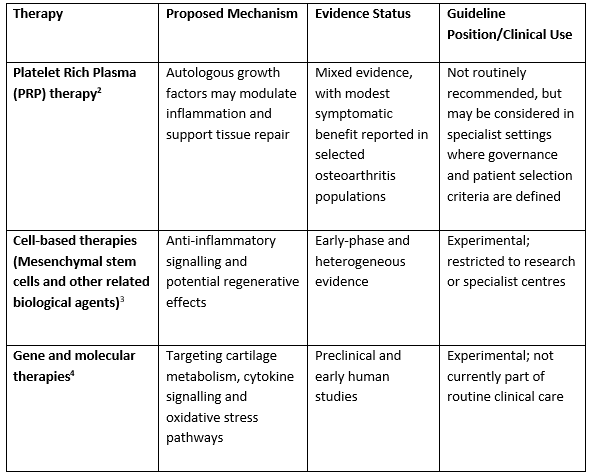
table

Across current clinical guidelines, regenerative therapies are positioned as adjuncts to established conservative management rather than replacements, with use generally confined to specialist or research settings.



Artificial intelligence (AI) and machine learning models are increasingly being developed to help predict which patients are most likely to progress to severe disease or require joint replacement. These tools typically integrate demographic factors (i.e. age, sex), clinical data (i.e. pain severity, function scores), imaging features and metabolic and lifestyle risk factors.
 

Early studies suggest that AI models may outperform traditional risk stratification methods in predicting disease progression.[1] In the future, this could facilitate earlier referral of high-risk patients, more focussed use of imaging and interventions and more individualised follow-up intensity. However, clinical validation, transparency and integration into existing workflows remain major challenges that must be addressed before widespread implementation.

Predicting Risk with AI and Machine Learning


Artificial intelligence (AI) and machine learning models are increasingly being developed to help predict which patients are most likely to progress to severe disease or require joint replacement. These tools typically integrate demographic factors (i.e. age, sex), clinical data (i.e. pain severity, function scores), imaging features and metabolic and lifestyle risk factors.
 

Early studies suggest that AI models may outperform traditional risk stratification methods in predicting disease progression.[1] In the future, this could facilitate earlier referral of high-risk patients, more focussed use of imaging and interventions and more individualised follow-up intensity. However, clinical validation, transparency and integration into existing workflows remain major challenges that must be addressed before widespread implementation.


How Developments Might Change the Management of Patient Pathways


As predictive tools and regenerative treatment strategies mature, referral pathways are likely to evolve. Anticipated shifts include:

  • Earlier identification of high-risk patients, enabling timely intensification of conservative management
  • Delayed or reduced surgical referral for patients demonstrating sustained response to multimodal care
  • Greater use of personalised, layered conservative strategies, including exercise, weight optimisation, targeted pharmacotherapy and selected evidence-informed nutraceutical interventions


Collectively, these developments underscore the importance of robust primary care and MSK-specific management as the foundation of treatment, prior to consideration of surgical escalation.


Why Does Adoption of Innovation Lag Behind Research?


Despite a growing volume of research, translation into routine clinical practice remains slow. Adoption is often constrained by evolving or heterogeneous evidence bases, limited guideline endorsement, cost and commissioning pressures, gaps in clinician confidence or training and ongoing regulatory and safety considerations.[1]

Translation into practice is particularly complex for interventions that sit between traditional conservative management and advanced regenerative or surgical care. Nutraceuticals illustrate this dynamic. While variability in formulation and regulation has historically limited clinician confidence, 

standardised preparations with defined bioactive components are increasingly being evaluated within structured care pathways.

For example, research examining rose-hip preparations containing GOPO® suggests potential benefits for pain, physical function and inflammatory markers in selected osteoarthritis populations when used alongside exercise and lifestyle interventions.[1]

As predictive and personalised care models mature, such interventions may be incorporated selectively within prevention-focused and multimodal strategies — not as standalone solutions but as part of an integrated conservative framework.


Looking Ahead

As predictive tools, regenerative science and evidence-based conservative strategies mature, joint care pathways are poised to become more precise and proactive. Healthcare professionals are likely to see:

  • Greater use of predictive analytics in MSK triage
  • Improved patient stratification for conservative versus interventional care
  • Continued refinement of regenerative therapies, with clearer indications
  • Stronger emphasis on early, multimodal intervention
  • Increased integration of evidence-based nutraceuticals within standard care

Key Take-Home Message

The future of joint care is not about replacing established rehabilitation principles but about enhancing them. By combining early risk identification, evidence-informed adjuncts and personalised pathways, healthcare professionals can help patients maintain function, delay progression and optimise long-term joint health.


This site is intended for UK healthcare professionals only.


[1] Hohmann E, Tetsworth K, Glatt V. (2020). Is platelet-rich plasma effective for the treatment of knee osteoarthritis? A systematic review and meta-analysis of level 1 and 2 randomized controlled trials. Eur J Orthop Surg Traumatol. 30(6):955-967.

[2] Glinkowski, WM, Gut G, ?ladowski D. (2025). Platelet-Rich Plasma for Knee Osteoarthritis: A Comprehensive Narrative Review of the Mechanisms, Preparation Protocols, and Clinical Evidence. Journal of Clinical Medicine, 14(11), 3983.

[3] Cao M, Ou Z, Sheng R, et al. (2025). Efficacy and safety of mesenchymal stem cells in knee osteoarthritis: a systematic review and meta?analysis of randomized controlled trials. Stem Cell Research & Therapy, 16(1), 122.

[4]Varela-Eirín M, Varela-Vázquez A, Guitián-Caamaño A, et al. (2018). Targeting of chondrocyte plasticity via connexin43 modulation attenuates cellular senescence and fosters a pro-regenerative environment in osteoarthritis. Cell Death Dis, 9, 1166.

[5] Castagno S, Gompels B, Strangmark E et al. (2024). Understanding the role of machine learning in predicting progression of osteoarthritis. Bone Joint J,106-B(11):1216-1222.

[6] Sahi G, Tong Du J, Abbas A, et al. (2024). Current state of systematic reviews for platelet-rich plasma use in knee osteoarthritis, Orthopaedics & Traumatology: Surgery & Research, 110(1), 103735.

[7] Gruenwald J, Uebelhack R, Moré MI. (2019). Rosa canina - Rose hip pharmacological ingredients and molecular mechanics counteracting osteoarthritis - A systematic review. Phytomedicine. 60:152958.